
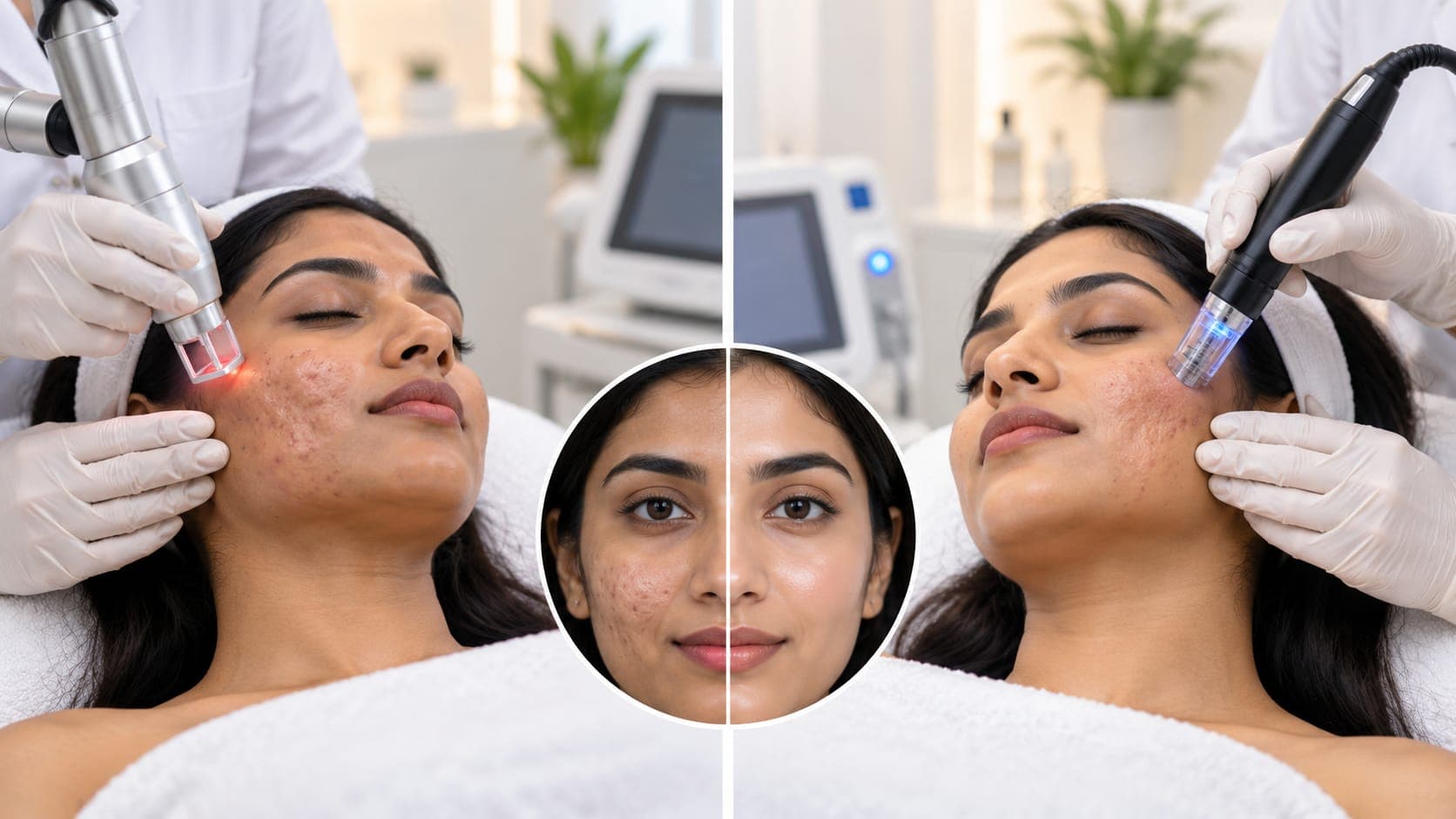
While acne typically resolves, the scars and textural changes it causes can persist long-term. Many patients find acne scars more bothersome than the original breakouts, particularly because topical creams alone often cannot effectively treat deeper scarring.
Acne scars vary significantly in type and depth, which means treatment must be individualised to your specific needs. The foundation of effective treatment is a thorough assessment of your scar type, skin tone, and the degree of skin involvement.
At DR Youth Clinic in Coimbatore, two commonly recommended procedures for acne scar improvement are fractional CO₂ laser treatment and microneedling radiofrequency (MNRF). Both treatments work to enhance skin texture and promote collagen remodelling, though they operate through different mechanisms. Learning how these treatments differ will help you make a more informed decision during your consultation and determine which approach may be most suitable for your skin.
Why Do Acne Scars Form?
Acne scars develop when inflammation from acne causes damage to the deeper layers of your skin. During the healing process, your skin may produce either too little or too much collagen, which can result in different types of scarring, including ice-pick scars, boxcar scars, rolling scars, and uneven skin texture. You may also experience post-acne marks and pigmentation changes.
Before beginning any acne treatment, it is important to have a proper evaluation to determine whether you have active acne, pigmentation concerns, true depressed scars, or a combination of these issues. Treating active acne first can help reduce the risk of developing new scars as your skin heals.
What Is Fractional CO₂ Laser Treatment?
Fractional CO₂ laser is a skin-resurfacing treatment that uses controlled laser energy to create microscopic treatment zones within the skin. This process is designed to trigger your skin's natural healing response and encourage new collagen formation. Over time, these changes may help reduce the appearance of acne scars and improve overall skin texture.
Fractional CO₂ laser treatment is commonly recommended for:
• Boxcar acne scars
• Some rolling scars
• Uneven skin texture
• Enlarged-appearing pores
• Certain deeper acne scars
If you are seeking acne scar treatment and texture improvement is a primary goal, fractional CO₂ laser may be a suitable option to discuss with your dermatologist. It is important to understand that treatment intensity, the number of sessions required, and recovery time will vary based on factors such as your scar depth and individual skin type. Your dermatologist will personalise a treatment plan based on your specific needs.
What Is MNRF Treatment?
Microneedling Radiofrequency (MNRF) is an advanced treatment that combines ultra-fine needles with controlled radiofrequency energy to address your specific skin concerns. During the procedure, radiofrequency energy is delivered to precise depths beneath your skin's surface, creating targeted treatment zones that stimulate your skin's natural collagen production and remodeling process.
This treatment is effective for rolling and boxcar acne scars, mild-to-moderate skin texture irregularities, enlarged pores, and overall skin quality improvement. Because the energy delivery can be precisely calibrated and customized based on your scar depth and individual skin characteristics, your treatment plan can be tailored to your unique needs for optimal results.
CO₂ Laser vs MNRF: What Is the Difference?
CO₂ laser and microneedling radiofrequency (MNRF) work through different approaches to skin improvement. CO₂ laser uses controlled laser energy to gently resurface the skin's outer layer, making it effective for addressing visible texture irregularities and surface-level concerns. MNRF, meanwhile, uses fine needles to deliver radiofrequency energy into the deeper layers of your skin, stimulating collagen production beneath the surface while preserving the outer skin layer. Neither treatment is right for everyone—choosing between them depends on several personal factors, including the type of scarring you have, your skin tone, how your skin responds to pigmentation changes, any previous treatments you've received, and the amount of recovery time that fits your schedule. During your consultation, our team will help determine which option aligns best with your specific needs and goals.
Which Treatment Is Better for Deep Acne Scars?
Deep acne scars rarely respond to a single treatment. Different scar types require different approaches—some improve with resurfacing alone, while others need subcision or TCA CROSS, often combined with CO₂ laser or microneedling RF for optimal results. This is why choosing the right skin treatment clinic in Coimbatore matters. The best clinics assess each scar individually rather than applying the same treatment to every patient. At DR Youth Clinic, we begin acne scar treatment planning with a thorough evaluation of your scar pattern, depth, skin type, and whether active acne is still present—ensuring your treatment is tailored to your specific needs.
What About Recovery Time?
Recovery timelines vary based on the specific procedure and your individual healing response.
After CO₂ Laser treatment, you may experience redness, sensitivity, dryness, swelling, or peeling as part of the initial recovery phase. Since CO₂ laser resurfacing removes the outer skin layers, the visible recovery period can be longer depending on the treatment intensity used.
After Microneedling Radiofrequency (MNRF), you may notice temporary redness, mild swelling, or sensitivity. The recovery period is generally shorter for most patients, though this depends on the treatment depth and intensity selected for your skin.
Regardless of which treatment you choose, carefully following your personalized aftercare instructions is essential for optimal healing. Sun protection is particularly important during recovery, as recently treated skin requires extra protection from UV exposure due to increased sensitivity.
How Many Sessions Are Needed?
The number of treatment sessions required varies for each patient and depends on several important factors. Your personalized treatment plan will be determined by the specific type of acne scars you have, how deep they extend into the skin, your individual skin type and sensitivity, any previous scar treatments you may have undergone, the intensity of the treatment we recommend, and how your skin responds to healing.
Some patients experience gradual improvement after just a few sessions, while those with deeper or more complex scarring patterns may require multiple treatments or a combination approach to achieve optimal results. It is important to understand that collagen remodeling—the natural process through which your skin repairs and rebuilds itself—takes time. Therefore, results are typically assessed gradually over the course of your treatment journey rather than immediately after individual sessions. Your dermatologist will monitor your progress and adjust your plan as needed to ensure the best possible outcome.
Final Thoughts
Two powerful technologies lead modern acne-scar treatment: fractional CO₂ laser and microneedling radiofrequency (MNRF). CO₂ laser excels at resurfacing the skin and triggering collagen remodeling, while MNRF uses controlled radiofrequency energy combined with microneedling to stimulate collagen at precise depths. Choosing between them isn't one-size-fits-all—it depends on your scar type, skin tone, downtime tolerance, and specific treatment goals. That's why the first step toward your best results is a professional skin assessment. Two scars may appear identical, yet your skin's unique needs may require a completely different approach.
Frequently Asked Questions
Which is better for acne scars, CO₂ laser or MNRF?+
Can CO₂ laser completely remove acne scars?+
How many MNRF sessions are needed for acne scars?+
Can CO₂ laser and MNRF be combined?+
Should active acne be treated before acne scars?+
Key Benefits
Improves acne-scar appearance
Helps reduce the visibility of rolling, boxcar and other suitable acne scars.
Stimulates collagen production
Both treatments encourage natural collagen remodeling for smoother-looking skin.
Improves uneven skin texture
Can help make rough, pitted or irregular skin appear more even
Reduces the appearance of enlarged pores
May help refine overall skin texture and pore visibility.
Customizable treatment
Energy depth and intensity can be adjusted based on scar type and skin condition.
Suitable for combination treatment
CO₂ laser and MNRF may be combined with procedures such as subcision or TCA CROSS when appropriate
Gradual, natural-looking improvement
Skin quality may continue improving over time as collagen remodeling takes place.
Targets different scar depths
CO₂ laser focuses more on resurfacing, while MNRF can deliver energy deeper into the skin.
| CO₂ Laser | MNRF | |
|---|---|---|
| How It Works | Uses fractional laser energy to resurface the skin and stimulate collagen production. | Uses fine microneedles with radiofrequency energy to stimulate collagen at controlled depths. |
| Best For | Often used for boxcar scars, uneven texture and deeper surface irregularities. | Often used for rolling scars, boxcar scars, enlarged pores and uneven texture. |
| Downtime | May involve more visible redness, peeling and recovery depending on treatment intensity. | Usually involves temporary redness and mild swelling, with relatively shorter downtime for many patients. |
| Skin Resurfacing | Provides stronger surface resurfacing and texture improvement. | Focuses more on collagen remodeling beneath the skin surface. |
| Sessions Required | Multiple sessions may be recommended depending on scar depth and skin response. | Multiple sessions may also be required depending on scar type and treatment goals. |

Reviewed By
Dr.Niveditha Bharathi
consultant doctor
BSMS cosmetologist · 13+ years experience


