
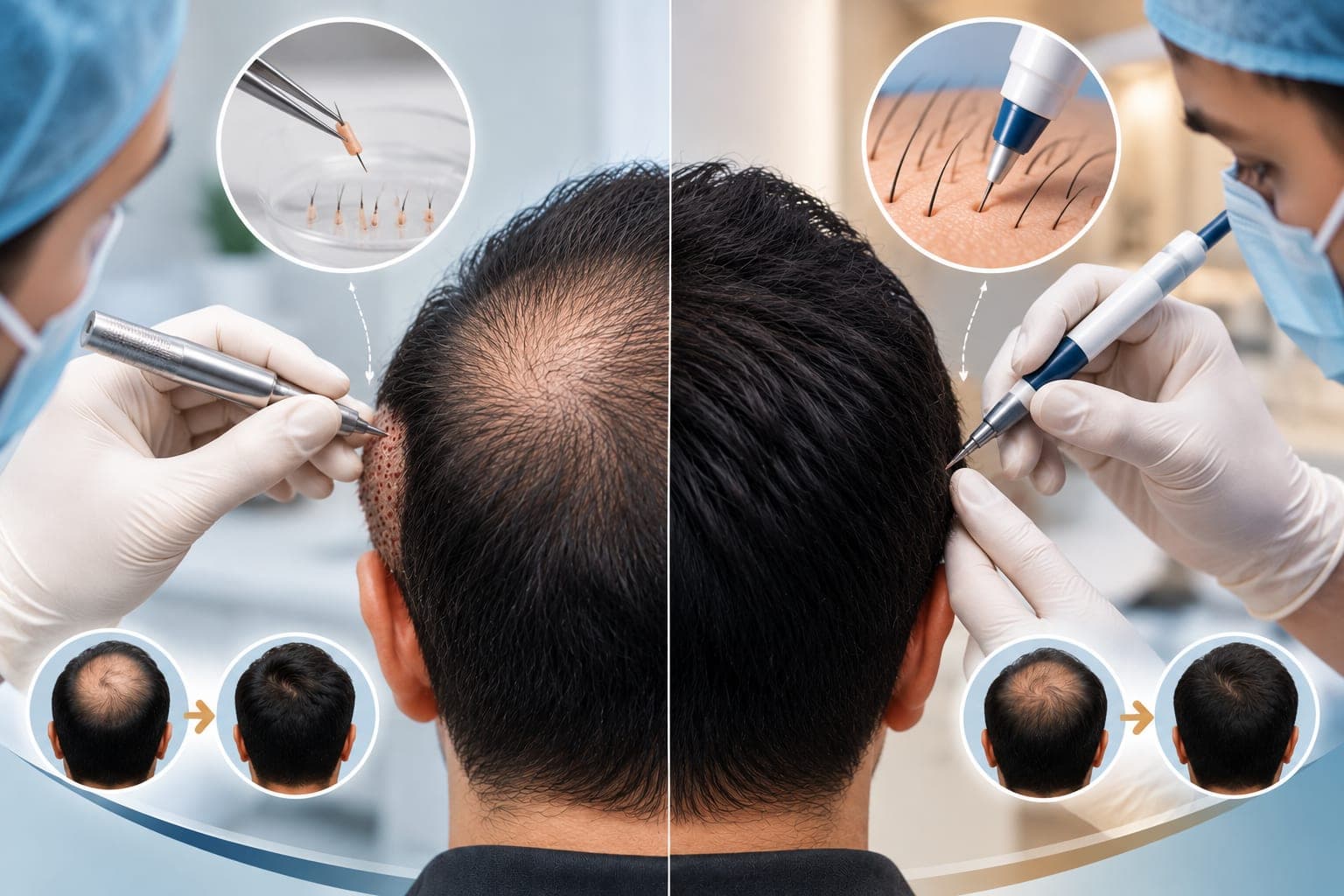
Navigating hair transplant options can feel overwhelming when you encounter terms like FUE and DHI. While both techniques restore hair, they differ significantly in how grafts are extracted, handled, and implanted. The most effective hair transplant method isn't necessarily the newest—it's the one tailored to your specific hair loss pattern, donor area characteristics, and long-term goals. When comparing FUE and DHI hair treatments in Bangalore, understanding the distinctions in cost, recovery time, and expected outcomes empowers you to make a more informed decision with your hair specialist.
What Is FUE Hair Transplant?
Follicular Unit Extraction (FUE) is a hair transplant technique in which individual hair follicles are carefully extracted from donor areas, typically the back or sides of the scalp where hair is naturally resistant to thinning. These follicular units are then prepared and precisely implanted into areas experiencing hair loss or thinning.
A key advantage of FUE is that it does not require removing a continuous strip of scalp tissue. Instead, individual grafts are extracted using small punches, which may result in minimal scarring and a quicker recovery compared to other methods. This technique can be used to address various concerns, including hairline restoration, frontal hair coverage, crown restoration, and treatment of other suitable areas affected by hair loss.
What Is DHI Hair Transplant?
Direct Hair Implantation (DHI) is an advanced hair restoration technique that uses a specialized implanter pen to place individual hair grafts. While the graft extraction process is similar to FUE (Follicular Unit Extraction), DHI distinguishes itself during implantation, where the pen allows our surgical team to precisely control the direction, angle, and depth of each graft placement. This level of precision can be particularly beneficial for restoring hair in specific areas where exact placement matters.
However, DHI is not suitable for every patient. The right technique for you depends on several factors, including your pattern of hair loss, the strength of your donor hair, the total number of grafts you require, and your overall treatment plan. During your consultation, our specialists will evaluate these factors to determine whether DHI or another hair restoration method is most appropriate for your individual needs.
FUE vs DHI: What Is the Main Difference?
The key difference is usually how the grafts are implanted.
FUE
In Follicular Unit Extraction (FUE), individual hair follicles are carefully removed from the donor area—typically the back or sides of the scalp where hair is naturally resistant to loss. Small incisions are then made in the areas experiencing hair thinning or baldness, and the extracted follicles are precisely placed into these recipient sites to restore hair growth.
DHI
In Direct Hair Implantation (DHI), hair grafts are carefully extracted and loaded into a specialized implanter device, which allows them to be placed directly into the scalp. Both DHI and other hair transplant techniques work by moving healthy hair follicles from the donor area to areas where hair is thinning or absent. The success of your results depends on several factors working together: the specific technique used, how carefully the grafts are handled throughout the procedure, precise hairline design tailored to your features, appropriate management of the donor area, and the skill and experience of your surgical team.
FUE vs DHI Hair Transplant Cost
Hair restoration is a significant investment, and cost is understandably an important consideration for many patients. Unlike standardized procedures, there is no single fixed price for hair restoration techniques because the final cost depends on several individual factors.
Your treatment cost may be influenced by:
• The number of grafts you require
• The extent and pattern of your hair loss
• The size of the area being treated
• The condition and availability of donor hair
• The specific technique selected (FUE or DHI)
• The expertise and experience of your surgical team
• The complexity of designing your hairline
• The clinic's facilities and the level of follow-up care provided
In some cases, DHI may involve higher costs because the implantation process uses specialized instruments and may require additional surgical time. However, when evaluating treatment options, cost alone should not be your primary decision factor. A lower price does not necessarily indicate better value, just as a higher price does not guarantee superior results. We recommend discussing all aspects of your treatment plan, including cost and expected outcomes, with your specialist to make an informed decision.
Which Technique Has Faster Recovery?
Recovery timelines vary among individuals. Both FUE and DHI are minimally invasive hair transplant techniques. After your procedure, you may experience mild redness, swelling, tenderness, or small scabs in the treated areas. Depending on your surgeon's guidance, many patients resume light daily activities relatively soon after treatment. While DHI is sometimes described as offering faster recovery, individual results differ significantly.
Your recovery depends on several factors, including the number of grafts transplanted, your scalp's sensitivity, how well you follow post-procedure care instructions, and your body's natural healing response. Strict adherence to your surgeon's aftercare recommendations is essential for optimal results, regardless of which technique you choose.
Which Gives Better Results: FUE or DHI?
Both FUE and DHI techniques can deliver natural-looking hair restoration results when performed with care and precision. The quality of your outcome depends on several interconnected factors, including thoughtful hairline design, accurate graft placement angles, healthy graft survival rates, adequate donor-area characteristics, your individual hair thickness and texture, appropriate placement density, and consideration of your expected long-term hair-loss pattern.
A meticulously performed FUE procedure can achieve excellent results, and DHI can similarly provide natural-looking outcomes when suitable for your specific situation. Rather than asking which technique is universally superior, the more meaningful question to discuss with your surgeon is: which approach is best matched to your particular hair-loss pattern and donor-area qualities?
FUE vs DHI: Which One Should You Choose?
FUE hair transplantation may be recommended if you require a larger number of grafts or need broader scalp coverage. DHI (Direct Hair Implantation) may be preferred when precise placement in specific areas is important for your results. However, there is no single approach that works for all patients.
Your doctor will recommend the most suitable technique after carefully assessing your degree of hair loss, the quality and quantity of your donor area, your scalp condition, and your aesthetic goals. In some cases, addressing ongoing hair loss alongside your transplant procedure may also be part of your treatment plan to optimize your long-term outcome.
Final Thoughts
Both FUE and DHI hair restoration techniques can deliver effective results when you are a suitable candidate and your treatment is carefully planned. FUE involves extracting individual hair follicles and then implanting them into areas of hair loss. DHI uses a similar principle but employs specialized instruments that allow for more direct placement of grafts. The cost, recovery timeline, and final outcomes will differ based on your individual circumstances. Rather than deciding between these techniques based on online information alone, we recommend beginning with a comprehensive professional evaluation of your hair, scalp condition, and hair loss pattern. Your ideal treatment plan should be tailored to your specific needs, including your available donor hair, the extent of your hair loss, and your personal goals for restoration.
Frequently Asked Questions
Is DHI better than FUE?+
Which is more expensive, FUE or DHI?+
Does FUE leave scars?+
How long does a hair transplant take to show results?+
How do I know whether FUE or DHI is right for me?+
Key Benefits
Natural-looking results
Both FUE and DHI use your own hair follicles to restore thinning or bald areas with a natural appearance.
Long-lasting hair growth
Successfully transplanted follicles can continue growing over time when they are taken from a stable donor area
No large linear scar
Unlike strip-based methods, FUE and DHI extract individual follicular units, which usually leaves tiny extraction marks.
Improves hairline appearance
Both techniques can be used to create a more defined and balanced-looking hairline.
Precise graft placement
DHI allows controlled placement of grafts, while FUE also offers flexibility in designing natural-looking coverage
Suitable for different areas
These techniques may be used for the hairline, temples, crown and other suitable thinning areas.
Relatively quick recovery
Many patients can return to normal daily activities within a short period, depending on the procedure and individual healing.
Personalized treatment
The number of grafts, placement pattern and technique can be planned according to your hair-loss condition and donor-area strength.
| Row Label | FUE Hair Transplant | DHI Hair Transplant | |
|---|---|---|---|
| Technique | Individual follicles are extracted and implanted into prepared recipient sites. | Extracted follicles are implanted using a specialized implanter pen. | |
| Implantation | Recipient channels are usually created before graft placement. | Grafts can be placed directly with controlled depth, angle and direction. | |
| Cost | Generally more affordable, depending on graft count and clinic. | May cost more due to specialized tools and implantation technique. | |
| Recovery | Usually a relatively quick recovery with mild redness or scabbing. | Recovery may also be quick, depending on graft count and individual healing. | |
| Best Suited For | Often considered for larger areas requiring broader coverage. | Often considered when precise graft placement and density are important. |

Reviewed By
Dr. TEJASHWINI GR
Consultant doctor / aesthetic physician
BAMS, MD( AYU), FFAC · 1+ years experience


